
Conservation Camp Departure Paths
Humboldt Conservation Camp was an NDOC minimum-custody men's fire and conservation camp operated with the Nevada Division of Forestry. A move away from the camp could have been an internal NDOC transfer. It could also reflect parole, full discharge, or another authorized placement.
The old location alone cannot resolve the outcome. NDOC demographic, booking, parole, and release tables track state custody. The Humboldt County Sheriff does not hold the controlling state-prison release record.
| Record clue | Meaning |
|---|---|
| New NDOC institution | Transfer within state custody |
| PAROLE status | Community supervision, subject to current verification |
| INACTIVE-DSCHREL | Full discharge or release from that NDOC record |
| Release-table event | Dated state exit event; check for later return |
Confirm Camp Release Records
Use the NDOC offender search. Offender ID is the best key because names and aliases can vary.
- Search by Offender ID or carefully matched name and demographics.
- Read the overall status and every sentence row, not just the first booking.
- Check institution, sentence county, parole data, Sent. PED, Sent. PEXD, and release entries.
- Distinguish transfer, parole, and full discharge. A past release does not rule out a later return.
- Request an official record from NDOC Records and Information when portal data conflicts.
The Humboldt released-inmate search explains when a county record is needed instead.
Camp Records After Closure
The historical facility page can identify the former program and location, but it is not proof that the camp remains active. Direct record requests to NDOC, which owns the offender and release data.
Nevada Department of CorrectionsRecords and Information / Offender Management Division
Use the official NDOC contact page for current routing and hours
Ask for the offender ID, booking history, institution movements, parole status, and release events needed to distinguish transfer from community release.
Humboldt Camp Is Shuttered
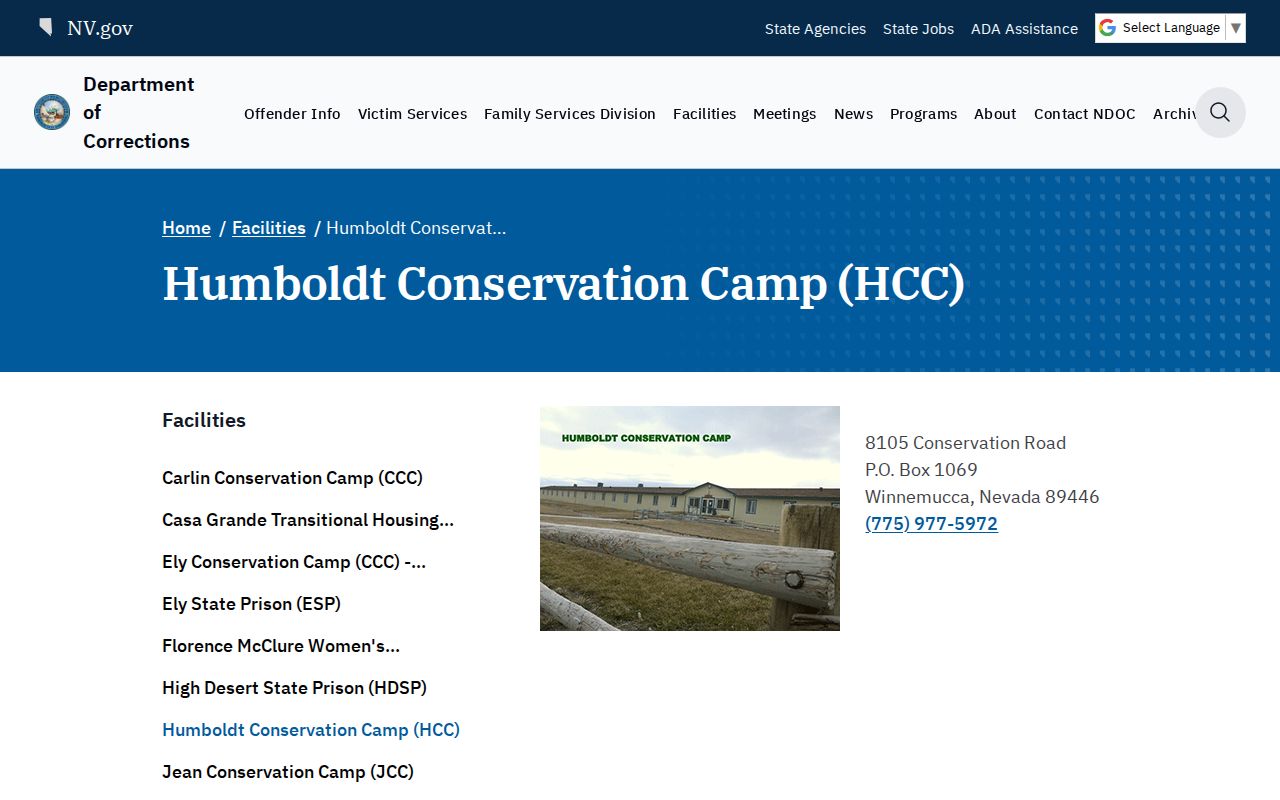
The current NDOC facilities list marks Humboldt Conservation Camp “SHUTTERED.” A legislative budget-closing document states that it closed in FY2024, remains mothballed, and projected zero offenders for FY2026 and FY2027.
The historical HCC facility page remains online. Treat it as history. It must not be read as evidence of current operations or releases.
The official facilities list visually confirms the status:
Historical Humboldt Release Trap
An old HCC location is a housing fact from a state-prison record. When the camp closed, departure may have been a transfer to another NDOC site. Only a release event, parole status, or discharge record supports an exit from NDOC custody.
Check all booking rows because one discharged sentence can coexist with another active sentence. A monthly Parole Board grant is also not the physical exit record. Confirm the later NDOC release entry and any approved supervision plan.
Read Humboldt NDOC Fields
The NDOC result separates identity data from sentence and movement evidence. Identification fields include name, Offender ID, age, physical descriptors, aliases, institution, and custody level. Booking rows add offense, sentence status, minimum and maximum, sentence county, sentence start, sentence type, Sent. PED, Sent. PEXD, Sent. MPR, and Sent. RRD.
Sent. PED is the parole eligibility date. It is only the soonest release point if the Board grants parole and NPP approves the plan. Sent. PEXD is projected expiration and can move forward or backward as credits, conduct, judgments, or sentence aggregation change. Neither field alone proves that someone left Humboldt Conservation Camp or NDOC.
Use the release table for the dated event. It contains offender ID, offender booking ID, release date, and release description. Then check later bookings, because an old event does not rule out a subsequent return to state custody.
Humboldt Parole Evidence Chain
The Nevada Board of Parole Commissioners publishes monthly hearing schedules and action reports. A schedule shows that a hearing was planned, not that parole was granted. A person may be removed after transfer or an eligibility change and rescheduled when NDOC submits the name again.
Action reports provide stronger decision evidence. Match NDOC ID, offender name, location, commit county, action, action date, and effective or denied-to date. A Humboldt commit-county case can appear while the person is housed in another part of Nevada. That is expected because the sentence county and current institution describe different facts.
Even “Grant Parole” and an effective date do not establish the physical exit. Check plan approval and the later NDOC release event. NPP, not the Board, enforces community conditions and handles supervision warrants.
Humboldt Projected Date Limits
Nevada does not apply one blanket rule that every state prisoner serves roughly 85 percent. Sentence structure, offense-specific limits, aggregation, earned credits, forfeiture, restoration, and parole decisions affect each record. For offenses in the current statutory period, NRS 209.4465 generally provides monthly credit when behavior and assigned-duty rules are met, with possible additional work, study, education, or program credits. Exclusions and minimum-term restrictions make a web calculation unsafe.
Record Sent. PEXD and Sent. PED exactly as NDOC displays them and note the date checked. Then examine all active or aggregated sentence rows. A corrected judgment, concurrent or consecutive sentence decision, credit change, detainer, parole denial, or plan delay can alter the practical date.
Actual release is established after NDOC records the exit or transfer. The old camp location cannot supply that final fact.
Closure Versus Community Release
The legislative closure material says Humboldt Conservation Camp closed in FY2024 and was held in mothball status. Zero projected offenders for later fiscal years supports the closed status, but it does not say every person housed there was released to the community. NDOC could transfer people between institutions as operations changed.
For each historical record, build a timeline: last HCC housing entry, next institution or movement, Board action if any, parole-plan evidence, and the release-table event. If the next institution is another NDOC site, the person remained in state custody. If PAROLE appears, verify the supervision start. If INACTIVE-DSCHREL appears, inspect every sentence and later booking before concluding full discharge.
This timeline is the main safeguard against turning facility closure into a false mass-release claim.
Request Historical Camp Records
When the public NDOC result is incomplete, make the request person-specific. Provide the Offender ID, full name and aliases, approximate HCC housing period, sentence county, and the booking or sentence row at issue. Ask for releasable institution movements, parole data, and release events that distinguish a transfer from an exit from state custody.
NDOC's public data is useful for research but carries an unofficial-record warning. The Offender Management Division is the route when an official calculation or reconciliation is needed. Preserve the agency response and note the date, because projected dates and current status can change.
The Humboldt County Sheriff is not the custodian of these state-prison records merely because the camp stood in Humboldt County. A Sheriff jail release request concerns the county Detention Center. An HCC history request belongs with NDOC.
Humboldt Camp Status Comparison
Three labels answer three different questions. “SHUTTERED” describes the facility today. An old HCC institution field describes where a person was once housed. A release description records what happened to a particular NDOC custody episode. None can replace the others.
| Evidence | What it establishes | What it does not establish |
|---|---|---|
| NDOC facility list | Camp is shuttered | Individual release outcome |
| Historical HCC page | Former mission and operator | Current operations |
| Institution movement | Housing changed | Community release |
| Release-table event | Dated NDOC exit description | No later return |
Reading all four sources together resolves most historical confusion without turning the camp's closure into a claim about one offender.
Supervision After Camp Release
If NDOC shows PAROLE after an HCC history, Nevada State Police Parole and Probation is the supervising agency. Humboldt County is within Northern Command, and the Winnemucca field office provides a local verification route. The Nevada Board of Parole Commissioners made the release decision, but NPP enforces conditions and handles warrants.
Probation is different. It comes from a court and may occur without an NDOC prison term. An HCC record points to state prison history, so a later probation case should be verified through its own judgment rather than assumed from the camp entry.
Supervision ends through expiration, discharge, or another formal action. Silence in S.A.V.E. or an old portal result does not prove that the term ended. Use the Board action, NPP route, NDOC parole table, and any discharge record that applies.
Nevada S.A.V.E. may provide a registered notice about custody or supervision, but released people can disappear from its public search. It is not an official historical release record. For a former camp resident, use S.A.V.E. as a notification lead and return to NDOC or NPP for confirmation.
A parole violation can also produce a later custody event. Board outcomes include continuation, revocation, early discharge, short revoke-and-reinstate actions, and no action. Match the action to the NDOC ID and date. Never let the former HCC institution field obscure a later supervision or custody episode.
The evidence chain ends only when the relevant question is answered: transfer, physical release, current supervision, or final discharge. Each requires its own source.